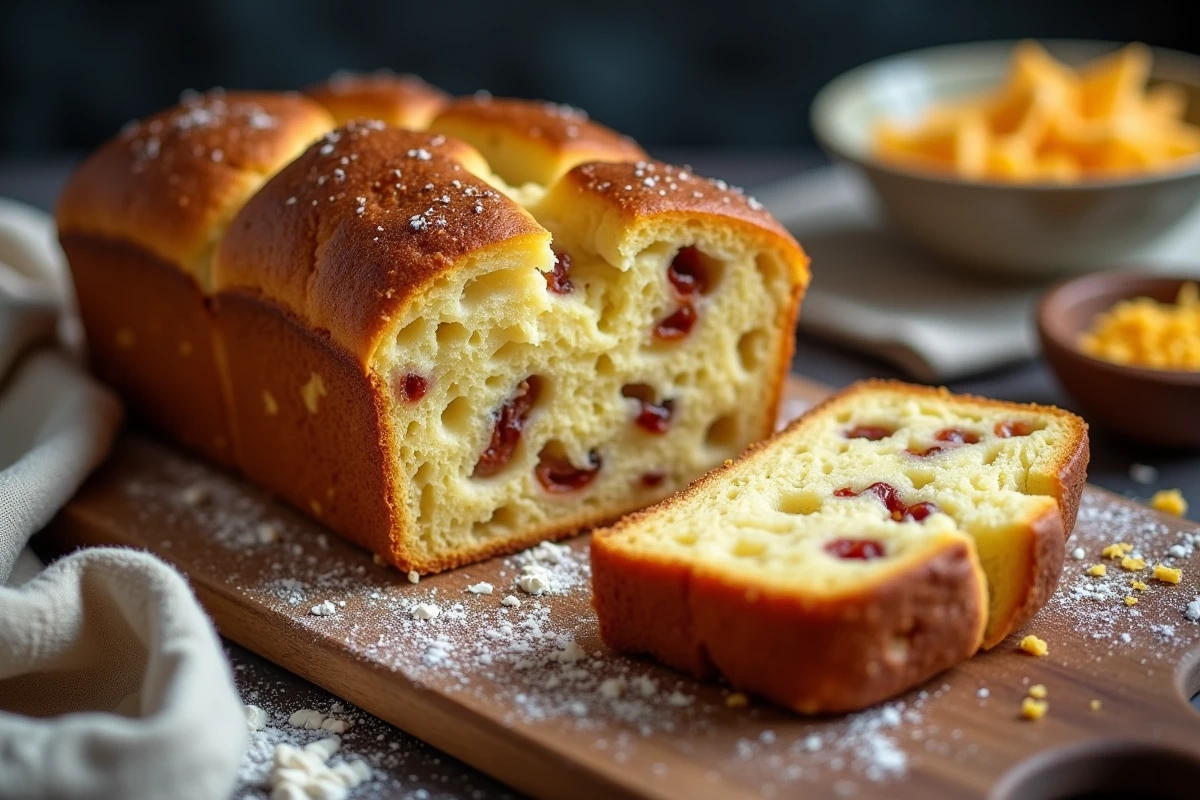
A moist savory cake relies on a precise balance between dough hydration, fat content, and cooking time. If not measured correctly, the bacon and cheese cake can turn into a dry brick or collapse when unmolded. Understanding the role of each ingredient allows for an airy crumb that remains tender even the next day.
The role of fermented liquid in a moist bacon and cheese cake
Most savory cake recipes use whole milk as the only liquid. The result is acceptable, but the crumb dries out quickly after cooling. Replacing half of the milk with buttermilk or plain yogurt radically changes the texture.
Buttermilk adds a slight acidity that softens the gluten network. The crumb becomes finer, denser, and retains moisture better for several hours. Milk kefir produces a comparable effect, with the added benefit of lactic ferments that aid digestion.
Specifically, for a standard cake, keep the same total amount of liquid, but divide it between milk and fermented product. The acidity of buttermilk also reacts with baking powder, enhancing the rise without needing to increase the amount. Several chefs specializing in fermentation confirm that this moist recipe on Trop Facile gains even more lightness with this partial substitution.

Choosing flour and fat: two underestimated levers
Flour T45, T55 or a blend with an ancient variety
Flour T45 (very white, low bran) produces a light cake but dries out quickly. T55, slightly more complete, retains more water in the crumb. A T55 blend with a small portion of spelt flour extends the moistness without weighing down the texture.
Spelt absorbs more water than regular wheat. This superior absorption capacity requires a slight increase in liquid, but the result is noticeable from the first bite: the crumb remains soft even after a night in the refrigerator.
Olive oil or melted butter
Melted butter adds flavor, but it solidifies when cooled and hardens the crumb. Olive oil stays liquid at room temperature, which maintains a moist texture even when served cold at an appetizer. A blend of both (half melted butter, half olive oil) offers the best compromise between flavor and softness.
Preparing the bacon and cheese before incorporation
Throwing raw bacon into the batter is a common mistake. The bacon releases water and fat during cooking, creating moist pockets in the cake. Sautéing the bacon dry for a few minutes beforehand allows excess water to escape and concentrates their smoky flavor.
Drain them on paper towels, then let them cool. Adding them while still hot to the batter risks melting the cheese prematurely and creating sticky clumps.
For the cheese, coarsely grated cheese distributes better in the batter than finely grated cheese, which tends to clump together and sink to the bottom of the mold. Keep a handful of grated cheese to sprinkle on top before baking: this creates a golden, slightly crispy crust.

Baking and managing salt in a bacon cake
Temperature and baking time
An oven that is too hot sears the crust before the center is cooked, resulting in a cake that is golden on the outside but wet in the middle. Preheat the oven to moderate convection heat. If after a certain time the blade of a knife comes out clean, the cake is ready. It’s better to take the cake out slightly early than too late: residual heat finishes the cooking outside the oven.
Let the cake rest in its mold for about ten minutes before unmolding. This resting time allows the crumb to stabilize and reduces the risk of breaking.
Adjusting salt when the bacon and cheese are already salty
The bacon and cheese already contain a notable amount of salt. Adding salt to the batter without tasting often results in doubling the necessary amount. The best practice is to not salt the batter at all, or to add only a tiny pinch.
French health recommendations on reducing salt have been reaffirmed in recent years, and a well-filled savory cake does not need additional salt to be flavorful. Freshly ground pepper and a pinch of nutmeg enhance the flavors without overdoing the sodium.
Variations that change the result without complicating the recipe
A few simple adjustments allow for flavor variations while maintaining the moist base:
- Replace some of the bacon with caramelized onions, which adds a sweet softness that contrasts with the remaining smokiness.
- Add chopped sun-dried tomatoes: their concentrated acidity enhances the cheese without adding excessive moisture.
- Substitute cheese with aged Comté or Beaufort, which melt more creamily and bring more complex aromas.
- Incorporate pitted black olives cut in half for a Mediterranean touch, slightly reducing the olive oil in the batter.
These variations work because they respect the balance of hydration-fat-filling. Each wet addition (tomatoes, onions) must be compensated for by careful draining or a slight reduction of liquid in the batter.
The bacon and cheese cake keeps for two to three days wrapped in a clean cloth at room temperature. A quick pass in a warm oven before serving restores its freshly baked texture. Sliced thick for a meal or in cubes for an appetizer, it also freezes very well in individual slices.