A pair of sneakers ordered online arrives at your home, the box seems fine, the logo is well placed, and the sole appears to be compliant. However, counterfeit sneakers sold on the web have reached a level of finish that even deceives seasoned collectors. Recognizing the authenticity of shoes purchased online relies on a set of precise checks, not just a simple visual impression.
Superfakes and UV Analysis: What the Eye No Longer Sees
Chinese counterfeits of models like the Nike Air Jordan have evolved into what specialists call “superfakes.” These copies replicate materials, stitching, and labels with a precision that makes them undetectable to the naked eye.
Yet, a method still underutilized in Europe allows for their detection: ultraviolet light analysis. Industrial glues and certain surface treatments used by official manufacturers react differently to UV light compared to copies. A UV lamp costing just a few euros is enough to reveal traces of glue absent on the original, or non-compliant fluorescent patterns.
Before relying solely on the seller’s photos, keep in mind that visible details (logo, box, barcode) are now reproduced almost perfectly. The quality of materials to the touch, a pronounced chemical smell, and the reaction to UV light remain more reliable indicators than appearance alone. If you’re looking for reviews on the site snipes.fr, these physical criteria usefully complement feedback from other buyers.
Authentication by Artificial Intelligence: Free Applications to Know
Since 2024, several mobile applications have been using artificial intelligence to analyze your sneaker photos and detect counterfeits. The adoption of these tools has accelerated, including on major marketplaces like StockX and GOAT, which integrate them to reduce disputes between buyers and sellers.
Have you noticed that some online listings display a “verified” or “authenticated” badge? This badge often relies on automated analysis. Applications like CheckCheck or Legit Check allow any buyer to submit their own photos for an opinion.
The process is simple: you photograph the pair from several angles (sole, inner label, stitching, box), the algorithm compares these images to a database of authentic models, and then returns a verdict. Reliability has improved thanks to feedback from experts like those at Legit App, who have trained the algorithms with thousands of real cases.
These tools do not replace a complete physical examination, but they effectively filter out gross copies and highlight points to check more closely.
Free Hybrid Verification: Combining AI and Sneakerhead Communities
Paid authentication services (ranging from a few euros to around twenty depending on the model) are not the only option. Combining an AI application with the opinion of a local sneakerhead community offers a free and often more comprehensive verification.
Why this choice? Because AI excels at measurable defects (proportions, stitching alignment, label typography), while an experienced enthusiast spots contextual anomalies: a model sold at an abnormally low price, a colorway never produced in that size, or packaging that does not match the marketing period.
Here’s how to proceed concretely:
- First, submit your photos to an AI authentication application to get an initial automated diagnosis in a few minutes.
- Then, share the same photos, along with the application’s result, in a local sneakerhead group (Reddit forums, dedicated Facebook groups, specialized Discord servers).
- Request opinions by specifying the exact model, the price paid, and the original online store, as this information helps members spot inconsistencies that the AI may not detect.
- If doubts persist, suggest a physical examination during a local sneaker meetup, where members can handle the pair directly.
This hybrid approach works particularly well for novice buyers who do not yet have the eye to distinguish critical details.
Labels, Codes, and Box: Manual Checks That Still Matter
Even with AI and communities, some manual checks remain useful at the time of receipt.
The inner label is the first element to examine. On an authentic pair, the typography is sharp, the characters are aligned, and the product code matches the one printed on the box. A slightly blurry font, irregular spacing, or a code that does not match the box are warning signs.
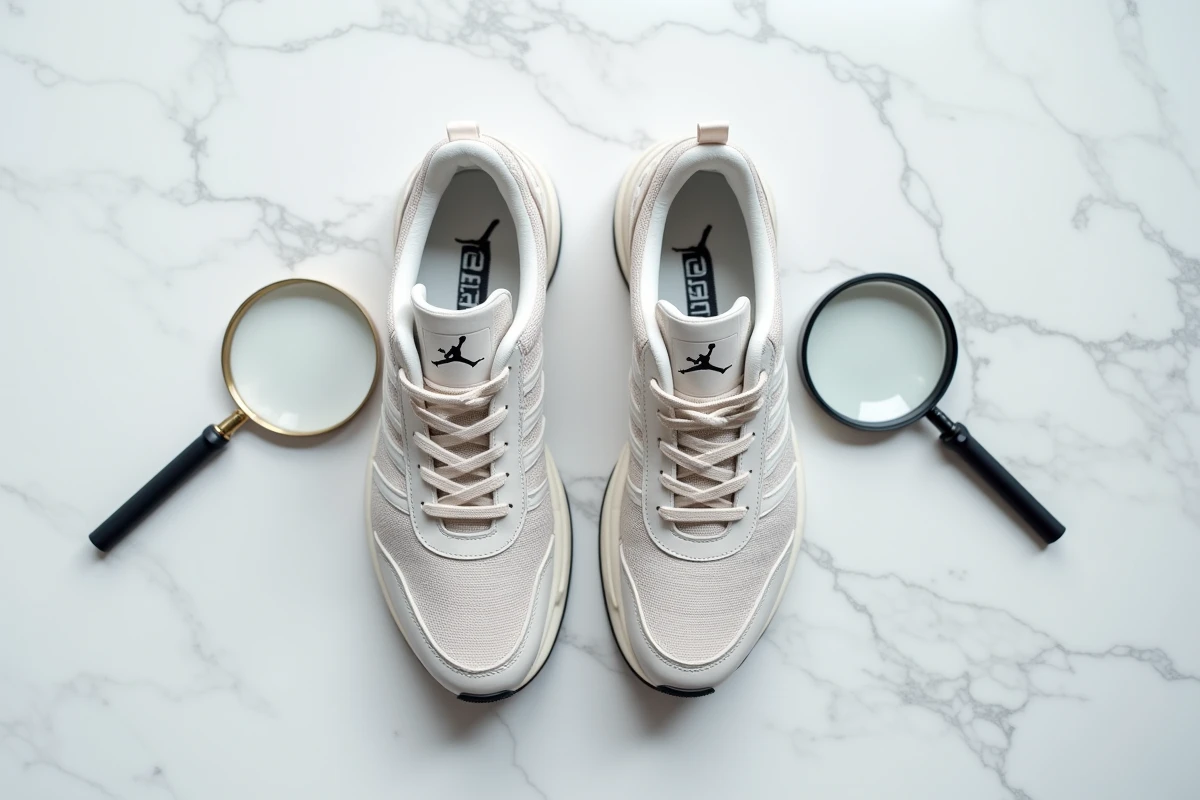
The box itself deserves attention. Brands use specific cardboard with consistent weight, color, and finish. Cardboard that is too thin, misaligned printing, or a repositioned sticker often betray a counterfeit.
- Check that the barcode on the box corresponds to the announced model (a quick online search is sufficient).
- Compare the materials of the shoe with high-definition photos of the model on the brand’s official site.
- Observe the stitching: on an authentic product, the stitching is regular and without protruding threads.
Digital Services Act and Obligations of Online Platforms
Since March 2025, the Digital Services Act requires European online platforms to deploy proactive anti-counterfeiting tools, particularly for luxury brand sneakers. Sites that do not comply with this obligation face fines.
In practical terms, this means that serious marketplaces must now actively filter suspicious listings before they are even visible to buyers. If an online store offers no mechanism for authenticity verification, this lack itself is a caution signal.
The sneaker counterfeiting market is evolving rapidly, but the tools available to buyers are progressing at the same pace. A UV lamp, a free application, and five minutes on a specialized forum are enough to significantly reduce the risk of buying a pair that is only authentic in appearance.