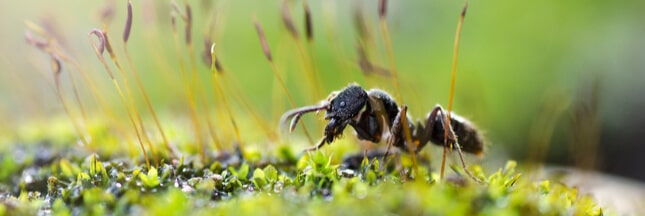
Ants in the vegetable garden seem quite logical. Every animal has a place in an ecosystem, no matter which one. Ants, in this case, are monsters on the biomass podium, representing 10-20% of the total biomass of the Earth with trillions of individuals in total… Knowing this, it is better to take a closer look to understand what ants do in our allocations.
Ants in the vegetable garden: a matter of diet
Most ants are omnivores, meaning they will eat both seeds and meat. This diet makes ants a kind of tireless cleaner, traveling significant distances to find their food.
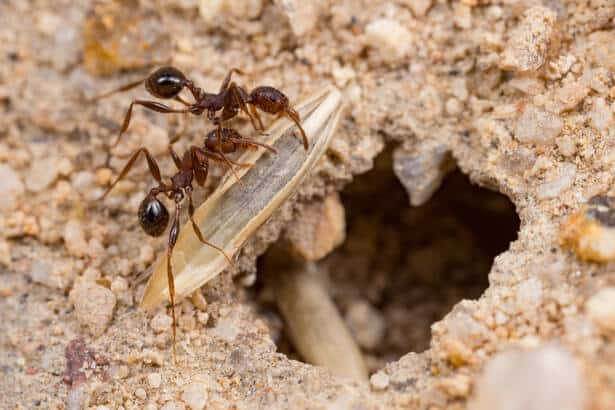
Ants welcoming a seed © Peter Yeeles
A small seed
In the case of ants searching for seeds to feed, their role in their dispersion is just beginning to be understood and is sometimes even used to restore some of the polluted natural areas.
Read also: Unusual: Can ants restore a threatened ecosystem?
A bit of meat
But ants also consume other insects, regularly hunting live animals such as caterpillars and others, but mainly feeding on animal carcasses such as fish, millipedes, and other beetles.
A bit of farming
In the garden, the ants that have the most impact on production will be those that literally farm other animals for the food they produce. This is the case, for example, with aphids or ladybugs.
Capable not only of defending the insects they farm from crop auxiliaries, ants can also move their “herd” from one plant to another when food starts to run low.
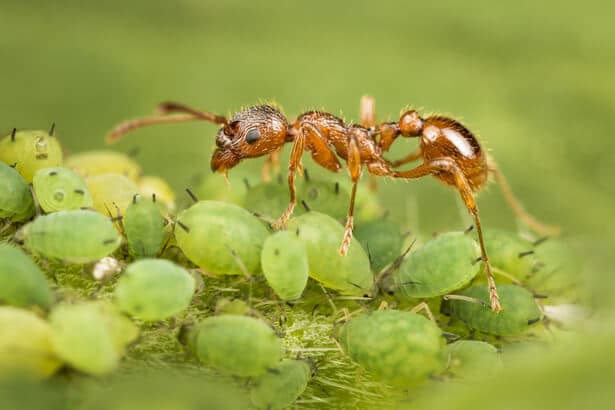
Ant caring for aphids © Frantisek Dulik
What to do if an ant nest is in the vegetable garden?
In fact, the whole problem lies in the resilience of an ant colony, that is, its ability to recover from whatever you do to make it move elsewhere. Yes, ants are stubborn!
There are several tricks if you are looking for how to get rid of ants, but in the case of ants in the vegetable garden, it’s not necessarily the same story. First, consider the fact that it is not necessarily useful to fight against the anthill at all costs.
Take the time to observe the colony and see if intervention is justified. If the need arises to do something…
Treating the symptom
This is not necessarily the most effective solution, but it has its merits. In fact, if you disturb — regularly — or if you kill the pests they farm for food, the ants are likely to move.
This allows you to use black soap as a spray to ensure that aphids or ladybugs do not remain on the plant. Once they fall to the ground under the action of black soap, these pests will suffer heavy losses. Birds, beetles, and other lizards will appreciate until the ants come to defend them properly and bring them back up to the plant.
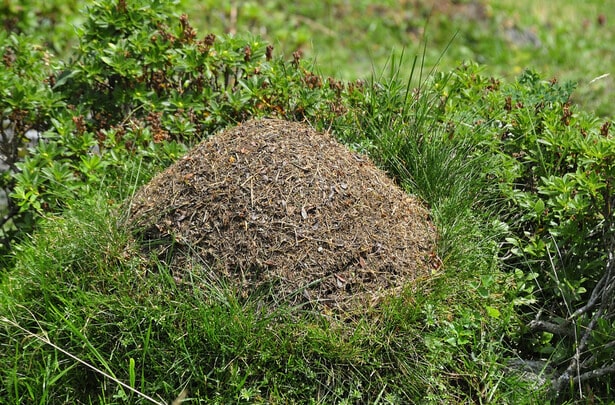
Ant Hill at the edge of the forest © Milan Rybar
All you have to do is repeat until the ants have too much work and decide to move.
Building a barrier
It is known that ants use trees of all sizes to climb and lift aphids. Then, we see the incessant position of these tireless workers on the trunk. Generally, a simple sticky collar placed around the tree is enough for the ants to abandon the idea of exploiting the plant.
In the garden, it’s a bit more delicate and, at the moment, it seems that only diatomaceous earth has shown real effectiveness in fighting ants biologically. Collected from quarries, diatomaceous earth is actually a type of sand made up of a myriad of skeletons of microorganisms. These skeletons are very sharp on their scale, so ants are sensitive enough to die… They will escape the areas where diatomaceous earth is spread, namely all your crops.
- Biological control: 18 animals to fight pests in the garden
Read also:
Illustration Banner: Garden ants in search of food © alfintofler
Tag: how to get rid of an anthill in your garden