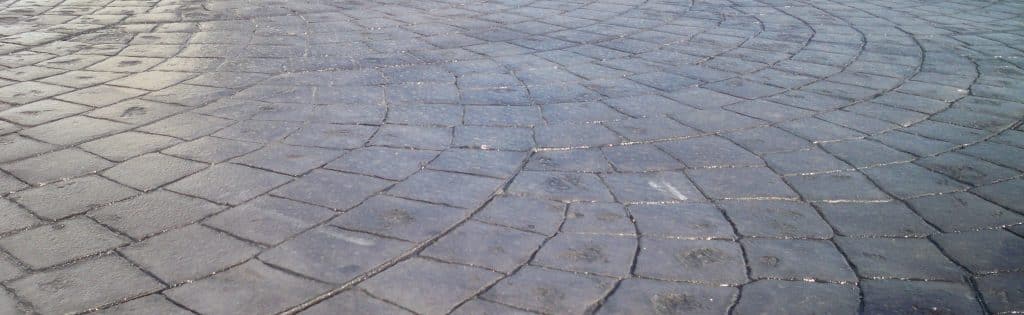
From the United States, stamped concrete is a very trendy decorative concrete for outdoor floors. This process owes its growing success to the aesthetics and originality it brings to surfaces. Durable and long-lasting, this concrete can imitate slabs, pavers, bricks, or wood to perfection. What exactly is stamped concrete? What are its advantages? Can it be easily implemented and what is its cost? Here are the answers to your questions…
A material with realistic material effects for outdoor decoration
Stamped concrete reproduces the appearance of natural materials, such as stamped concrete wood (photo), natural stone paving, brick…
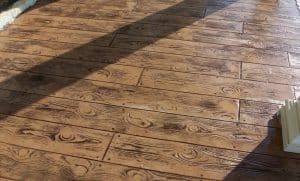 Wood plank appearance in stamped concrete.
Also known as imprint concrete or stamped concrete, the stamped concrete technique involves applying a stamp to the still fresh concrete to imprint a raised pattern.
The choice of stamps is very varied and allows for all types of decor. These stamps, also called molds or matrices, allow for the imitation of natural materials with deceptive realism such as stones, pavers, brick, wood, slate, and pebbles.
For more subtle effects, there are also “skins” or “textures” whose lighter reliefs help to structure the concrete.
You can also unleash your imagination with unique patterns, combinations of patterns, or inlays such as rosettes, wind roses, suns…
The color of stamped concrete is achieved by combining hardening colorants that are sprinkled and absorbed into the surface of the fresh concrete and by adding a mold of equal color. The latter prevents the adherence of the stamps to the fresh concrete and contributes to the coloration of the surface by settling into the recesses of the relief, creating shades.
The stamped concrete process, which gives three-dimensional relief effects, should not be confused with matrix concrete, for which patterns are created in only two dimensions.
In fact, the matrix concrete technique involves applying a frame (a kind of giant stencil 1m wide) on fresh concrete to simply draw the pattern. This technique is more limited in terms of possible renders.
Uses of stamped concrete
It can be used for all types of installations:
- Public installations: walkways, subdivision roads, sidewalks, pedestrian crossings, pedestrian streets, forecourts, squares, parking lots, school yards…
- Private services: stamped concrete terraces, driveways, garage entrances, garden paths, pool decks, patios…
Stamped concrete rotating driveway.
Custom and durable flooring
The ability to customize is the essential feature of stamped concrete. The possibilities are limitless durable material. The surface is protected by a varnish, making it very and the result greatly depends on your tastes and the skill of the applicator. Indeed, the combinations of patterns (more than 40 patterns to choose from, from the most discreet to the most structured) and colors are even more numerous than for natural materials. Whatever atmosphere you want to give to your exterior, you will be able to create your own universe. In addition to its aesthetic advantages, it is an easy to maintain alternative, for example, to tiles (which eventually break or peel off) or wooden coverings (a wooden deck that warps and darkens over time). Stamped concrete flooring avoids these problems for a reasonable cost. The prices of stamped concrete. Once completed, it lasts for many years. Only the surface varnish needs to be renewed approximately every 4 years. The prices are variable and depend greatly on the parameters of your site (preparation, configuration, access, surface,…) and the matrices used. If you want implementation by a professional, expect to pay around a hundred euros per square meter.
The advantages of stamped concrete are:
- Interesting quality/price ratio compared to natural materials;
- Easy adaptation to all landscape environments;
- Quick implementation;
- High resistance to traffic, abrasion, and weather;
- Simple maintenance.
The main steps in making stamped concrete
Here are the main steps to create stamped concrete:
- Pour conventional ready-mix concrete.
- Just after the concrete is drawn, color the surface of the fresh concrete by sprinkling a hardening colorant on the surface.
- Stamping: when the concrete begins to set (start of hardening), apply a release agent on the surface of the concrete and the underside of the matrices. The release of the mold usually takes place in the form of colored powder. It has the particularity of remaining in the rough edges of the footprints to give a true relief to your creation and provide it with a patinated look. The imprinting of surface patterns using silicone matrices can then begin. Once the entire surface is mapped, allow the concrete to harden.
- Once the concrete has hardened, it is necessary to clean the release agent and protect the surface with a stain-resistant product.
Application of the matrices.
The implementation of stamped concrete: a delicate operation
You can find products (matrices, stain hardeners, release agents,…) and specific tools for making stamped concrete (large magnesium float, large trowel, edging iron, joint iron, roller smoother,…). All you have to do is prepare for the use of concrete (BPE) delivered. However, do not be mistaken, the implementation of stamped concrete is very technical and requires real know-how. The finishes are particularly important to achieve an optimal result. If you have no experience with stamped concrete, practice on a small area (a few m2) or do not hesitate to call a professional.
Tag: more info on stamped concrete