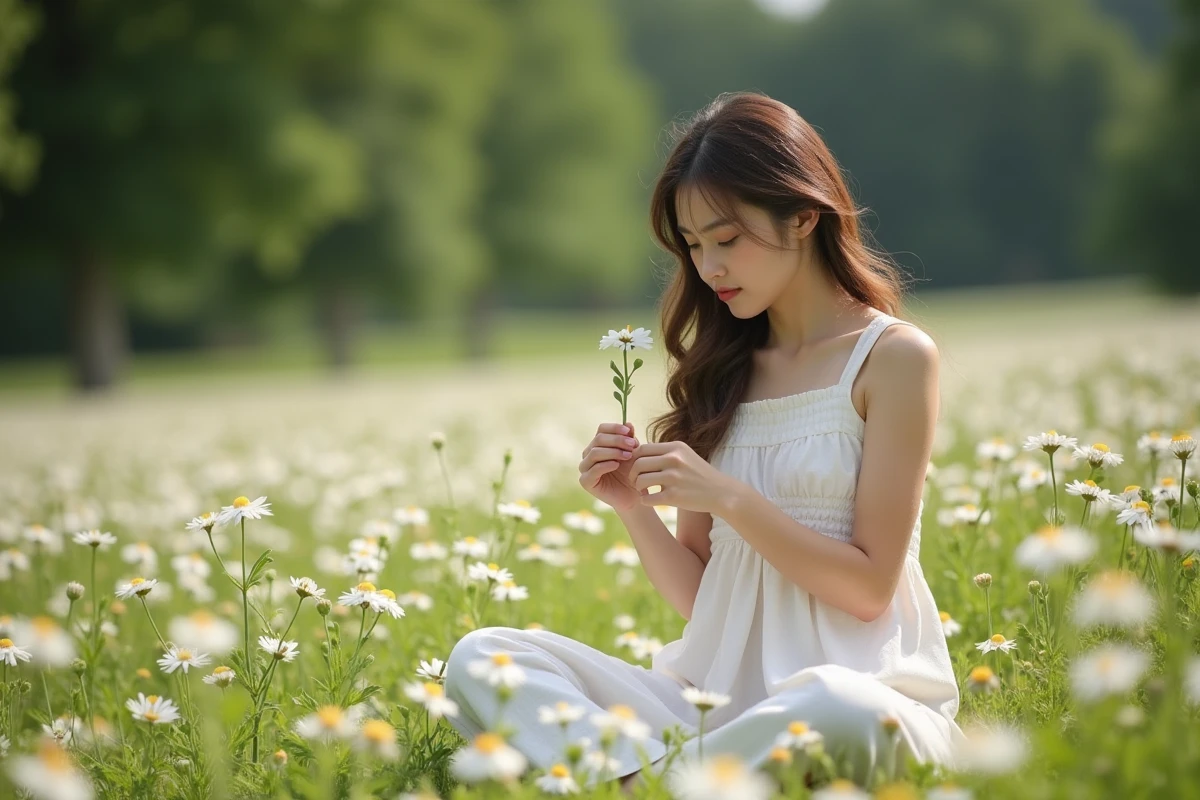
In ancient Rome, the daisy was part of purification rituals and was associated with fertility deities. In the Middle Ages, some beliefs attributed to this flower the ability to indicate truth during oaths. Even today, its symbolism varies according to regions and beliefs, oscillating between innocence, fidelity, and renewal.
From medieval manuscripts to contemporary folk traditions, its constant presence reveals a richness of meanings rarely matched in the plant kingdom. The daisy stands out for the breadth and diversity of its spiritual interpretations.
The daisy through history: origins, myths, and early meanings
A familiar symbol of the meadows and landscapes of France, the daisy belongs to the large family of Asteraceae. Beneath its apparent simplicity lies a dense history of stories and beliefs. In Roman mythology, the nymph Belides chose to transform into a daisy to escape Vertumnus, the god who governs the seasons. This tale of transformation has been passed down through the centuries, anchoring the meaning of the daisy as a symbol of purity and renewal.
Further north, in Scandinavian culture, the daisy is linked to Freya, the figure of eternal love and fertility. In the Middle Ages, the flower established itself in the European imagination, particularly in France: Charles IX, King of France, chose it as his royal seal, associating the daisy with loyalty and integrity. Christian traditions, for their part, make the daisy an echo of the Virgin Mary, embodying modesty and innocence.
Its name, ‘daisy’, comes from the Greek ‘margarites’, meaning pearl. In English, ‘daisy’ evokes the “day’s eye”: the flower opens at dawn and closes at night. To better grasp the richness of its spiritual meanings and symbolism, the symbol of the daisy on Le Jardineur offers an interpretation faithful to the millennia-old heritage of this discreet plant.
Why is the daisy so fascinating? Spiritual symbolism and hidden messages
If the daisy is so appealing, it is no coincidence. Its light corolla and golden heart give it a special place in our imaginations. From a spiritual perspective, its messages are multiple and nuanced. First, it is a solar symbol: the daisy evokes light, vitality, clarity. Look at it at dawn: its petals gently open to welcome the day, then close at nightfall, accompanying the cycle of the sun. This daily gesture embodies perseverance and resilience in the face of life’s variations.
The daisy also represents quiet strength. It persists in wild meadows, braving wind, rain, and drought. This resistance inspires respect: the daisy illustrates the balance between modesty and tenacity. In the realm of dreams, it often returns as a messenger of innocence, purity, and inner renewal. It encourages sincerity and authenticity, without ever falling into pretension.
To better understand the diversity of its messages, here is how the daisy reflects human values:
- Eternal love: much more than a simple petal-plucking, the daisy accompanies sincere heart’s impulses.
- Honor and chastity: this flower evokes uprightness, loyalty, a nobility that does not seek attention.
- Self-expression: giving a daisy reveals frank feelings, a radiant personality that does not deceive.
It is impossible to dissociate the daisy from great archetypes: it symbolizes childhood, the light of the soul, positivity despite adversity. Some traditions associate it with rose quartz, thus extending its aura of softness, calmness, and universal love.

From the language of flowers to world traditions: how the daisy expresses innocence, love, and hope
The daisy is never far when it comes to expressing emotions through the language of flowers. Its deceptive simplicity hides deep messages. The white daisy stands out as an emblem of innocence and purity: it is found in birth, baptism, or maternity bouquets. Offering a white daisy is to affirm absolute trust and unreserved affection.
The color palette further broadens the symbolic reach of the flower. The yellow daisy radiates joy, light, and lasting friendship. Pink nuances the tenderness of a blossoming love, while the red daisy boldly expresses passion. This floral language, passed down through generations, knows no borders: each bouquet becomes a discreet message, fully decoded only by the initiated.
It is impossible to ignore the famous petal-plucking game, “he loves me, he loves me not,” which has placed the daisy at the heart of popular culture. But the flower is also given on birthdays, unions, or to instill hope during uncertain times. It stands as a symbol of optimism, fidelity, and shared sincerity. Through the ages and uses, the daisy retains its ability to embody, without detours, the truest human feelings.
Among all flowers, few traverse the centuries, myths, and rituals as naturally as the daisy. It continues to open each morning, faithful to the light’s rendezvous, reminding us that true beauty knows how to remain simple and direct, even when it carries a thousand stories in silence.