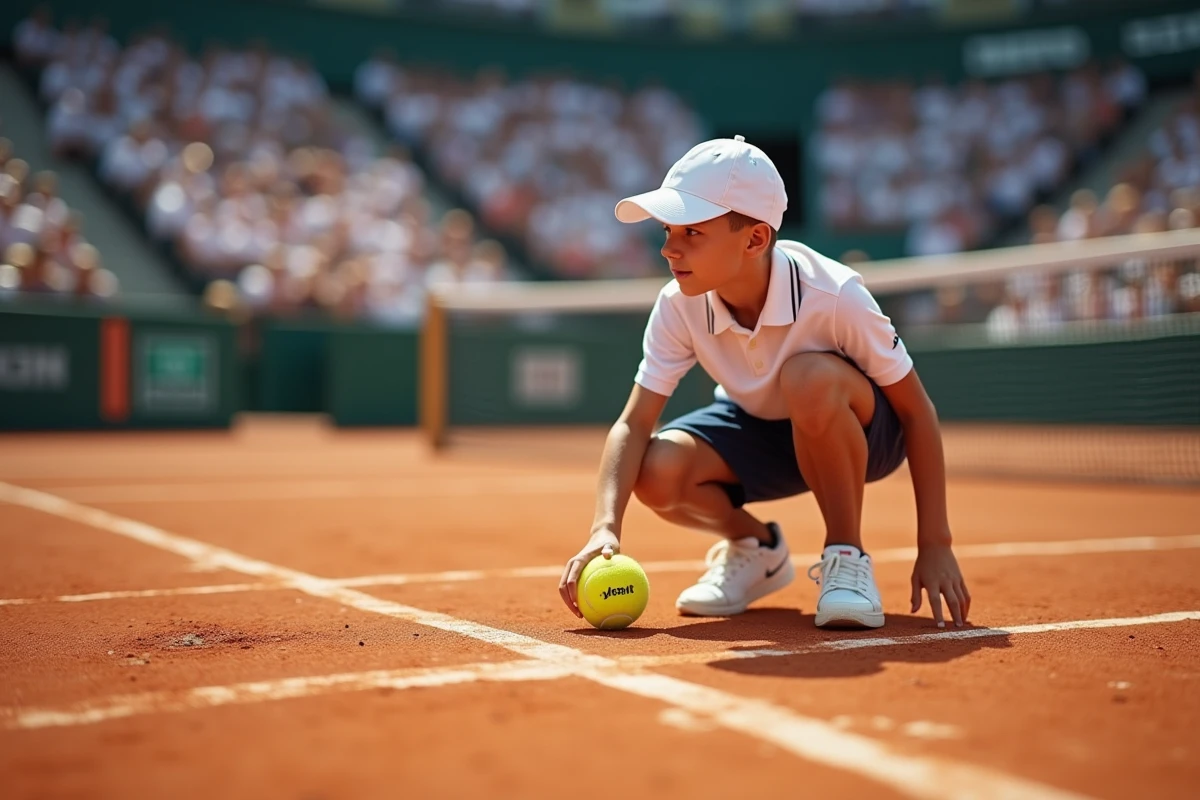
On the Philippe-Chatrier court, between two aces, a teenager sprints, retrieves the ball, and sends it back to the server in less than two seconds. This gesture, repeated hundreds of times per match, raises a question that many spectators ask: are these young people paid for this intense physical and mental work? The answer depends on the tournament, the country, and the legal status applied, and it holds some surprises.
Volunteering or Employment: The Legal Status That Changes Everything
We start with the point that conditions everything else: the legal framework. At Roland-Garros, ball boys and girls do not receive a salary. Their commitment is governed by the French Tennis Federation under a volunteer regime.
In practical terms, this means no employment contract, no payslip, no social contributions. The selected young people, usually aged 12 to 16, receive in return sports outfits, tickets to attend matches, and sometimes equipment grants. At Roland-Garros, ball boys and girls receive no remuneration.
The contrast with other Grand Slam tournaments is striking. At the US Open, ball boys and girls have part-time employee status and are paid by the hour. Thus, we find two opposing philosophies for the same role, depending on whether one crosses the Atlantic or not. To know precisely how much a ball boy or girl earns, one must first identify the tournament in question.
Remuneration of Ball Boys and Girls According to Tennis Tournaments
The model varies not only between the four Grand Slams but also across lower-level ATP and WTA competitions.
Grand Slams: Two Models Coexisting
Roland-Garros maintains a pure volunteer system. The selection, managed by the FFT, mobilizes thousands of applications each year for a few hundred positions. The absence of remuneration does not prevent fierce competition to gain access.
The US Open pays its ball boys and girls by the hour, with a seasonal employment status governed by American labor law. This difference reflects a distinct cultural approach to sports volunteering, not a question of financial means. The US Open pays its ball boys and girls as seasonal employees.
ATP 250 and Challenger Tournaments: The Post-Covid Trend
Since the post-Covid recovery, several ATP 250 or Challenger tournaments have shifted towards daily allowances or financial compensation for their ball boys and girls. The reason is pragmatic: the decline in volunteer applications among young people and travel constraints have pushed organizers to offer monetary compensation to ensure a sufficient workforce.
This gradual evolution contrasts with the maintenance of an almost entirely unpaid model in major French tournaments.
Outfits, Tickets, Network: What the Non-Financial Compensation Is Really Worth
To say that the ball boys and girls at Roland-Garros earn “nothing” would be reductive. Compensation takes other forms, and some have concrete long-term value.
- The complete outfits (shoes, technical clothing) provided by the tournament’s equipment supplier represent a direct material benefit, even if their market value remains modest
- The tickets offered to attend tournament matches, sometimes on the main courts, constitute access that spectators pay several hundred euros to obtain
- Access to a professional network in sports (coaching, event management, officiating) is the most underestimated return: former ball boys and girls testify that this experience has served as a springboard to training or internships in the sports industry
Interviews published with former ball boys and girls from Roland-Garros confirm that the main benefit is not financial but acts as a career investment for those who want to stay in the sports world.
Legal Risk in France: The Line Between Volunteering and Hidden Work
We touch here on a rarely addressed subject but one that is debated among sports lawyers. Since 2023, specialists in youth and sports law have begun to question the true nature of the commitment of ball boys and girls in French tournaments.
The reasoning is as follows: when an organizer imposes strict schedules, near-military discipline, a demanding selection process, and obligations of presence, the criteria for a subordinate relationship characteristic of employment are potentially met. The “in-kind remuneration” (outfits, tickets, grants) could then be reclassified as compensation for work, which would expose organizers to the risk of hidden work.
So far, no public procedure has resulted in this area. Feedback varies on this point depending on the consulted lawyers. The FFT carefully oversees the system, but the question remains open and could evolve if a former ball boy or girl or a parent decided to take the matter to the labor courts.
Selection of Ball Boys and Girls at Roland-Garros: What the Field Really Requires
The selection to become a ball boy or girl at the Roland-Garros tournament is not a simple registration process. It involves a process spread over several months, with specific physical and behavioral criteria.
- Candidates must be between 12 and 16 years old and be licensed in a tennis club in France
- The tests include speed, reactivity, throwing, and concentration under pressure
- Discipline on the court is non-negotiable: posture, silence, anticipation of players’ movements, stress management in front of thousands of spectators
- The competition among candidates is massive, with thousands of applications for a few hundred places retained each year
The level of physical and mental demand far exceeds that of simple ball retrieval. The selected young people train for weeks before the tournament, with specific sessions on clay to master movements, ball rolling, and positioning relative to the players.
This level of preparation partly explains why the debate about remuneration resurfaces each year during the Paris tournament. Such a structured and demanding commitment, without any financial compensation, remains an exception in the current international sports landscape.